Many experienced DeFi users assume that careful attention to contract addresses and gas settings is enough to avoid losses. That intuition misses a class of risks that arrive not from sloppy clicking but from complexity: composite calls, middleman contracts, approval chaining, and subtle token accounting errors. A wallet that simulates a transaction and reports precise balance deltas before you sign changes the decision from „trust my eyeballs“ to „inspect the machine’s calculation.“ That distinction matters when you routinely move liquidity, approve contracts, or use cross-chain bridges across 90+ EVM networks.
This commentary examines Rabby Wallet from the vantage of a U.S.-based DeFi power user: what its simulation and security features actually do, where they reduce real operational risk, where they leave gaps, and how to integrate Rabby into an institutional or sophisticated retail workflow without assuming it is a cure-all. I’ll isolate mechanisms, trade-offs, and practical heuristics you can reuse when evaluating any multi-chain wallet.
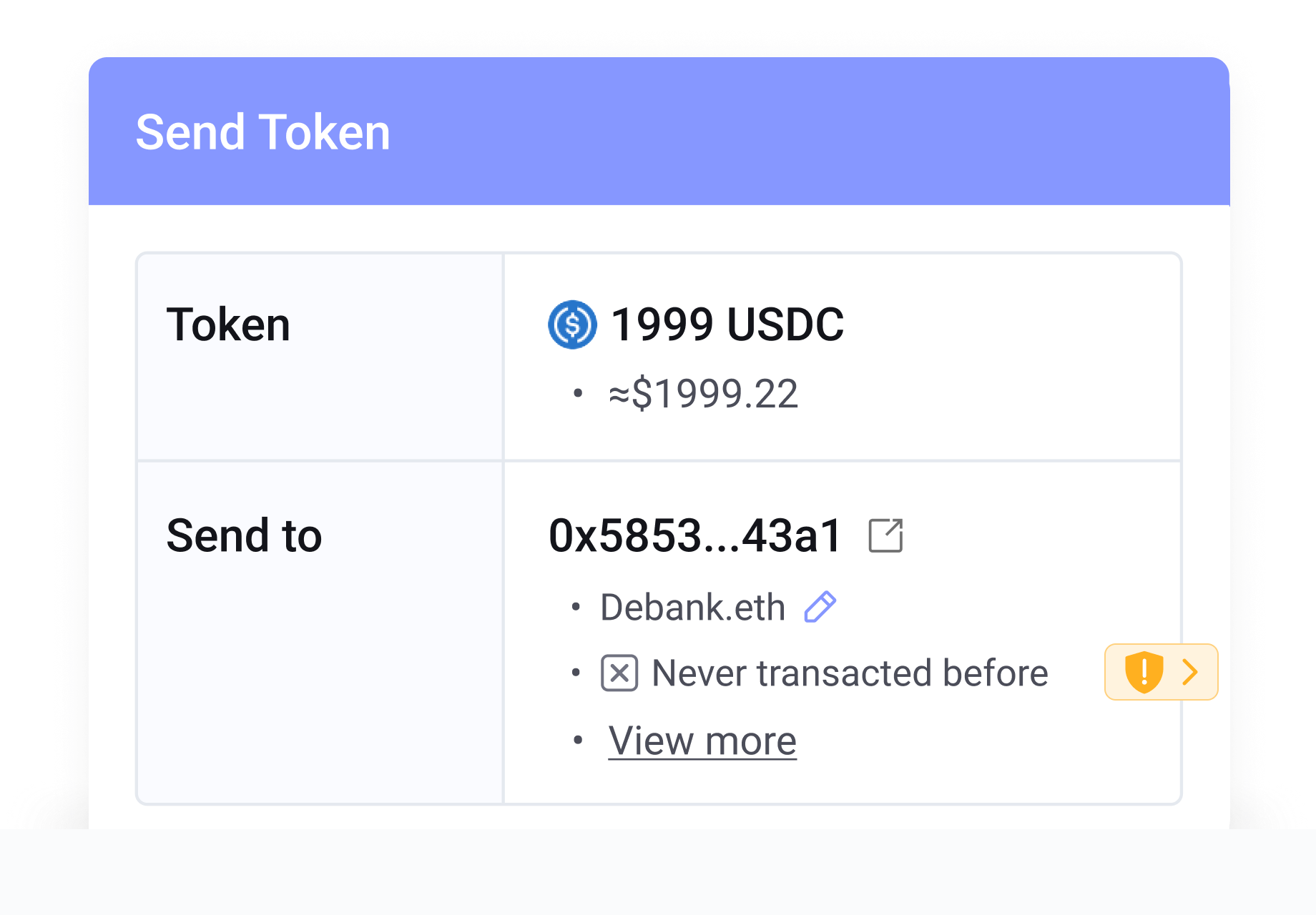
How Rabby’s security stack works — mechanism first
At its core Rabby layers three defensive mechanisms that are individually familiar but jointly important: pre-transaction risk scanning, transaction simulation, and active approval management. Each addresses a different point in the typical attack surface.
Pre-transaction risk scanning runs a set of heuristics and lookups against the contract and call data before signing. Practically, that means Rabby can flag previously hacked contracts, stale approvals, suspicious recipient addresses, or malformed approval requests. This is a correlation-and-signature-style defense: it recognizes patterns and historical bad actors rather than proving the intent of an arbitrary contract.
Transaction simulation is the stronger, mechanism-level control. Instead of presenting raw hex and leaving you to interpret it, Rabby executes the call against a local or remote EVM simulator to produce concrete outputs: estimated token balance changes, exact gas estimates, and fee breakdowns. That removes a major cognitive burden. You no longer need to translate low-level method signatures into business logic — the wallet shows you the net effect on your assets.
Finally, Rabby’s built-in approval revocation gives you a defensive posture after the fact: view and cancel token approvals granted to contracts and DEXes. This reduces persistent exposure when you have previously granted unlimited allowances to aggregators or yield strategies.
Where these features materially reduce risk — scenarios that matter
Three common, high-value scenarios show why Rabby’s design is relevant to DeFi operators in the US:
1) Complex batching or router calls: Many DEX trades and bridge operations use router contracts that bundle swaps, approvals, and transfers. Blind-signing such calls can move more assets than you expect. A simulation that reports token deltas prevents surprise drains.
2) Cross-chain gas shortfall: If you operate on multiple chains, it’s common to have funds on a destination network but no native gas token. Rabby’s cross-chain gas top-up facility is an operational convenience — you can fund gas on another chain without juggling multiple wallets or custodial bridges. That reduces friction and the temptation to use risky third-party services in a hurry.
3) Long-lived approvals and permission creep: Attackers often exploit existing unlimited allowances rather than breach your seed phrase. Rabby’s revocation tool closes this gap by making allowance hygiene explicit and discoverable.
Limitations, boundary conditions, and real trade-offs
No single wallet eliminates the need for operational discipline. Rabby has meaningful strengths — simulation, automatic network switching, hardware wallet support, and open-source code under MIT — but there are important limits to recognize before you rely on it as a single line of defense.
First, simulation is as good as the emulator and the chain state it uses. If the simulator runs against stale state, or if a contract behaves differently on-chain due to miner-provided values or MEV manipulations, the predicted balance changes may be inaccurate. Simulation reduces but does not eliminate the risk of unexpected outcomes.
Second, Rabby does not provide a fiat on-ramp inside the wallet, nor does it include native in-wallet staking. For U.S. users accustomed to integrated brokerages, that means you still need external services to acquire tokens or to stake via separate platforms — introducing additional custody decisions and KYC/regulatory steps.
Third, while Rabby supports hardware wallets and multi-sig integrations (Gnosis Safe, Fireblocks), the extension remains an additional software layer. Attack surfaces include the extension environment, browser vulnerabilities, and malicious browser plugins. Best practice is to pair Rabby with hardware wallets or multi-sig setups for high-value accounts and to avoid storing large balances in an extension-only hot wallet.
Comparative frame: what Rabby buys you versus alternatives
Compared with widely used alternatives (MetaMask, Trust Wallet, Coinbase Wallet), Rabby’s distinctive value proposition comes from simulation and network ergonomics. Automatic network switching reduces human error from manual chain changes — useful when you frequently hop between Arbitrum, Optimism, and Polygon. The transaction simulation feature is the most concrete differentiator because it converts opaque ABI calls into human-readable financial deltas.
However, if your workflow depends on fiat integration, custodial fiat rails, or in-wallet staking dashboards provided by exchanges, Rabby will feel like a more security-first, less convenience-focused choice. That trade-off is deliberate: the wallet emphasizes reducing execution risk over onboarding convenience.
Integrating Rabby into a DeFi workflow: a practical 3-step heuristic
Use this decision framework to decide how and when Rabby should be your default signing tool:
Step 1 — Risk-tier your wallets. Keep a small hot wallet for routine swaps and dApp interactions; use a hardware-backed Rabby account (or Gnosis Safe) for large positions or multi-sig operations.
Step 2 — Require simulation for any composite or large-value transaction. Treat Rabby’s simulated balance delta as mandatory evidence before approving; if a transaction’s simulation output is ambiguous, refuse or dissect the raw call in a dev environment.
Step 3 — Schedule allowance audits. Use Rabby’s revocation tool monthly (or after any grant) to revoke excessive permissions. This small operational habit closes the most common post-exploit vector.
For readers who want to try the extension directly, the rabby wallet extension page links to installers and documentation that can help you evaluate it in a test environment before migrating valuable funds.
Security history matters — and what the 2022 incident teaches us
Rabby’s team disclosed a 2022 exploit of a Rabby Swap contract that led to roughly $190,000 in losses. The response included freezing the affected contract, compensating users, and committing to enhanced audits. Two lessons emerge:
Lesson A — non-custodial does not mean invulnerable. Smart contracts, even those operated alongside a wallet, can contain vulnerabilities. Wallet-level protections reduce some client-side risks but cannot immunize on-chain contracts.
Lesson B — operational transparency and rapid mitigation can materially limit damage. The post-incident response is a practical test of governance and incident playbooks — an important signal for institutional users assessing counterparty and operational risk.
What to watch next — conditional scenarios that change the calculus
Three developments would materially alter Rabby’s value proposition for U.S. DeFi operators:
– If Rabby integrates a regulated fiat on-ramp with custody partnerships, it would lower onboarding friction but also change compliance and privacy trade-offs for users.
– Improvements in on-device deterministic simulation (less reliance on remote RPC nodes) would reduce state-staleness risk and increase simulation accuracy.
– Wider adoption of account abstraction and smart contract wallets could shift where simulation is most useful — at the wallet layer or at the contract-wallet interface. Watch whether Rabby adapts its UI and simulation logic to support ERC-4337-style flows.
FAQ
Does Rabby eliminate the need for hardware wallets?
No. Rabby supports hardware wallets and can improve signing ergonomics, but hardware devices still reduce key-exposure risk introduced by browser extensions and the host OS. For high-value accounts, pairing Rabby with a hardware wallet or multi-sig remains best practice.
How reliable are Rabby’s transaction simulations?
Simulations provide structured, high-value intelligence (token deltas, fee estimates) but are limited by the state used for execution and by dynamic on-chain behaviors like MEV or oracle-driven logic. Treat simulation output as a strong check, not an absolute guarantee.
Can Rabby protect me from malicious dApps?
Rabby reduces exposure by flagging known malicious contracts and suspicious approvals and by simulating transactions. However, it cannot stop a user from approving a malicious contract intentionally. User discipline and additional controls (hardware signing, multisig) remain necessary.
Is Rabby suitable for institutional use in the U.S.?
Yes, with caveats. Rabby integrates with multi-sig and enterprise custody solutions (Gnosis Safe, Fireblocks, Amber), which is crucial for institutional compliance and auditability. Institutions should evaluate operational controls, incident response readiness, and legal/regulatory implications before adopting.
Conclusion: Rabby is best understood not as a panacea but as an operational amplifier for security-conscious DeFi users. Its simulation and approval tools convert many hidden technical risks into concrete, inspectable outputs — a meaningful improvement for anyone who routinely composes multi-step DeFi transactions across multiple chains. Yet simulation cannot substitute for good key management, conservative approval practices, and an incident-ready operational posture. Use Rabby to reduce execution risk; don’t treat it as a substitute for defense-in-depth.